
Demilec Attic Insulation in Boulder City: A Homeowner’s Guide
Not all spray foam is the same compound. The blowing agents, cell structure and dimensional stability of budget two-part kits degrade measurably once an attic holds above 130°F, and a Boulder City attic can sit above that mark for roughly four months of the year. Demilec’s formulations are built for sustained heat. In short: Demilec closed-cell spray foam is the product we’d specify for a Boulder City attic deck because it holds its structure and insulates at temperatures where commodity foam starts to fail. If you’d rather not sort through that yourself, or just want a straight read on your attic, call (888) 291-3864 and we’ll take a look.
This guide walks through what actually separates Demilec from the foam you’ll find in a hardware-store kit, where it belongs in a desert attic, where it doesn’t, and how to confirm before install day that what you’re paying for is the real product.
What makes Demilec spray foam different from commodity foam?
Demilec closed-cell foam is a two-component polyurethane system whose formulation is engineered for dimensional stability under heat and humidity swings, not just a decent expansion ratio. That distinction shows up in three places that matter in Boulder City.
- Cell structure. Closed-cell foam cures into a dense matrix of sealed cells filled with a low-conductivity blowing agent. Cheap kits often use agents that diffuse out of the cells faster, and the foam loses insulating value as it ages. A stable formulation holds its gas and its R-value longer.
- Dimensional stability. Foam that shrinks or swells under heat cycling pulls away from framing and leaves gaps. At 130°F plus, unstable foam moves. Demilec’s closed-cell products are tested for stability across a wide temperature range, which is why they hold tight to rafters and joists through a desert summer.
- Adhesion and substrate tolerance. Attic decks are dusty, dry and often rough-sawn. Foam that doesn’t grab won’t seal. Demilec formulations are designed to bond to prepared wood substrates, which is why substrate prep is part of the specification, not an afterthought.
We install spray foam insulation from both Icynene and Demilec, and the reason a portfolio matters is simple: a homeowner’s attic conditions, not a crew’s preference, should pick the product. The right formulation in the right place outperforms a “good enough” foam in the wrong one.
Why closed-cell Demilec suits a desert attic
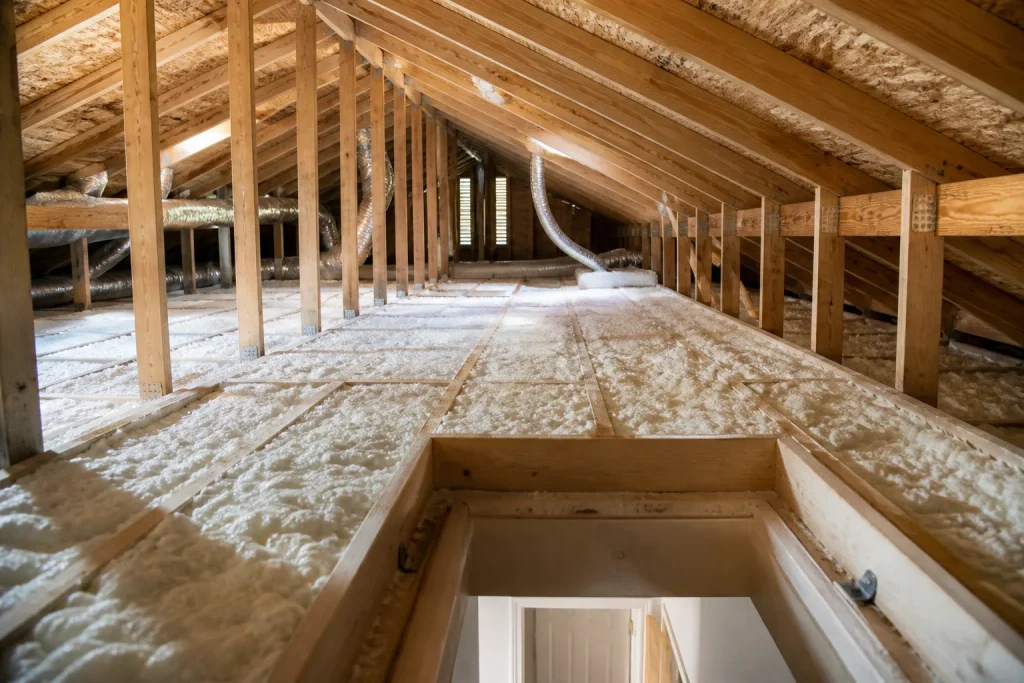
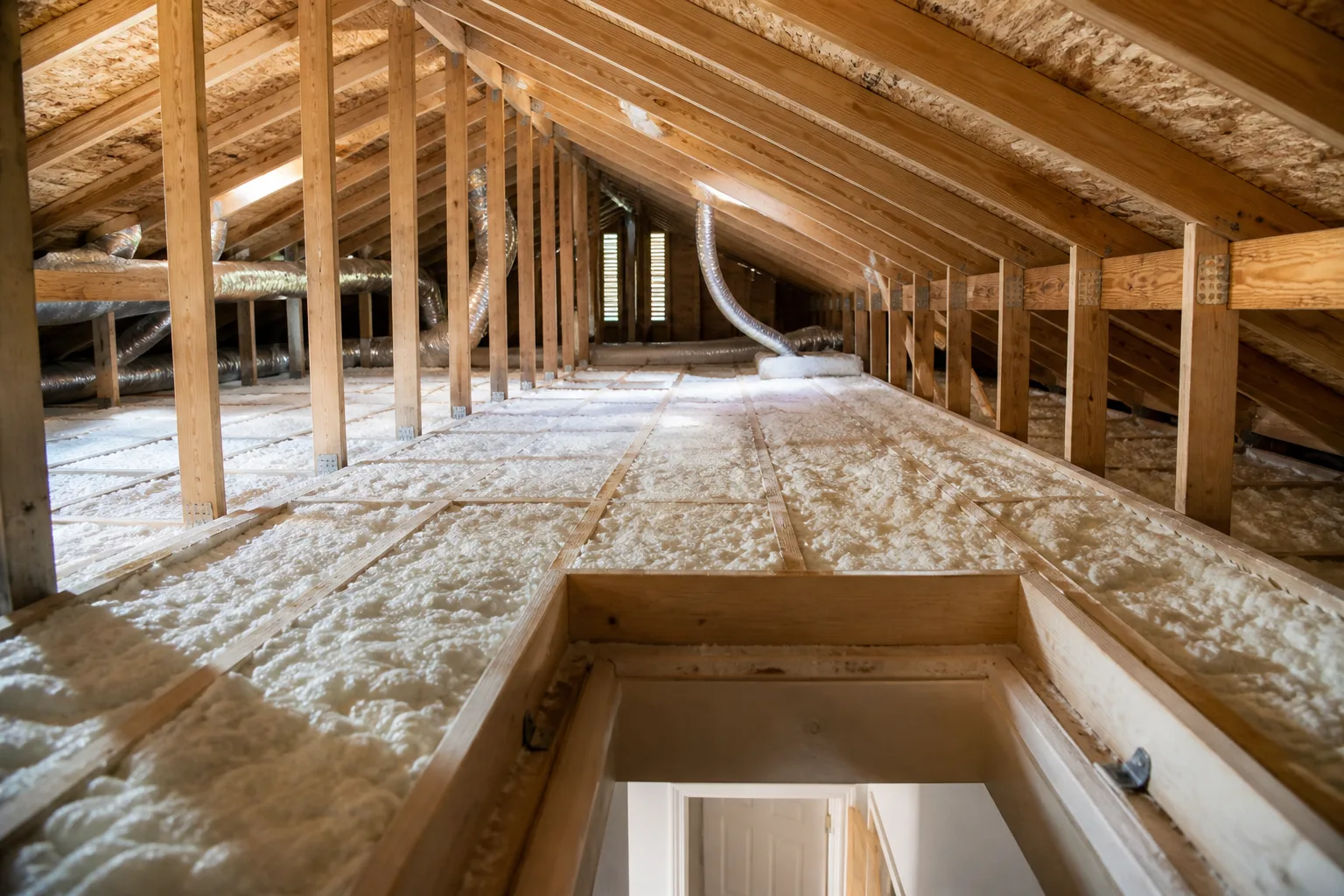
Closed-cell Demilec does two jobs in a single pass: it insulates, and it acts as an air and vapor retarder. In a Boulder City attic that dual function saves an install step. You’re not paying for foam and then a separate air-sealing pass or a vapor barrier.
Here’s why the second job matters so much locally. Boulder City’s climate swings from cold winter nights to furnace-hot summer afternoons. Every gap in the attic envelope lets conditioned air leak out and hot air leak in, and that pressure difference drives moisture movement too. A continuous closed-cell layer, applied to the attic deck or rafter line at spec thickness, shuts off both.
Open-cell foam also seals air, but its lower density and higher moisture permeability make it a poor fit for a deck application that sees that kind of temperature cycling and thermal load. In a desert attic, you want density and stability. Closed-cell delivers both.
If you’re comparing options side by side, this is where an attic specialist earns its keep: we match the material to your attic rather than the other way around.
When is Demilec open-cell the right choice in Boulder City?
Open-cell Demilec is not the right choice for a Boulder City attic deck. It’s the right choice in applications where you’re sealing, not insulating against extreme heat load, and where vapor needs to move. That includes:
- Interior walls. Open-cell foam fills cavities, seals air leaks and lets wall assemblies dry. Far less severe thermal load than an attic deck.
- Rim joists. The band joist at the top of a foundation is a notorious leak zone. Open-cell foam seals it effectively without the cost premium of closed-cell.
- Irregular cavities where you want an air seal more than a high insulation value.
For the attic deck, closed-cell is the specification. Understanding the difference is what separates a good install from an expensive retrofit that has to be redone.
What a proper Demilec installation looks like for a Boulder City attic
A correct Demilec installation follows a defined sequence. Here’s the specification we’d expect:
- Substrate check and prep. Confirm the deck is sound, dry and clean. Dust, debris and loose existing insulation come out first. Foam bonds to wood, not to a blanket of old material.
- Hatch and penetration sealing. The attic hatch is one of the biggest air leaks in most homes. Seal before you apply the broad layers so nothing is left uncompromised.
- Target thickness and R-value. Thickness is set for the specific R-value the job needs; you check that with your city’s building department during the estimate, because it depends on the home and the requirements in Boulder City. The written quote should state the target thickness in writing.
- Ventilation during off-gassing. Foam cures through a chemical reaction that releases vapor. A proper install includes temporary ventilation during the cure window and a documented re-entry time in writing.
How to verify you’re getting genuine Demilec
Spray foam is mixed on-site from two components. A contractor can substitute an unlabeled drum without telling you. That’s the biggest risk in the category, and it’s easy to get ahead of. Before any foam job starts, ask for:
- The product name and manufacturer in writing, on the estimate, not just spoken.
- The batch or lot numbers from the drums prior to install.
- The manufacturer’s technical data sheet for the exact product.
- Written cure and re-entry times specific to the product and thickness.
If a contractor hesitates to put any of that in writing, that’s the answer. Closed-cell foam is a significant investment, and the drum in the van should match the product on the quote.
When to call a pro
Spray foam involves pressurized chemicals, heat-generating exothermic reactions, and an attic that can reach temperatures dangerous to work in. This is not a safe DIY job. A trained installer manages ventilation, protective gear and the cure window; a homeowner in an attic in July with a two-part kit is a bad combination.
If you’re weighing spray foam against blown-in or batts and want a straight read on which fits your attic, our Attic Insulation Boulder City page covers the material choices, including CertainTeed batts and GreenFiber cellulose. Blown-in insulation from GreenFiber or mineral wool from Rockwool makes sense when air sealing is already handled and you’re just adding thermal resistance.
Related services in Boulder City: we install attic spray foam, blown-in and batts/rolls – whichever the job actually calls for.
The Bottom Line
Demilec closed-cell spray foam earns its place in a Boulder City attic because of the chemistry, not a label. Its formulation is engineered for sustained heat and dimensional stability, it seals air and vapor in a single pass, and it holds up where commodity kits degrade. Open-cell Demilec has a home in interior walls and rim joists; it just isn’t the attic deck product. And the most important step happens before install day: confirm the exact product, batch and cure times in writing.
We’ve seen attics where a cheap foam was sprayed and spec’d products where it wasn’t, and the difference shows up in gaps and pulled foam a few summers later. If you’re in Boulder City and need help, Attic Insulation Boulder City offers free estimates. Call (888) 291-3864. We answer 24/7. Fast dispatch from 7am to 7pm, Sunday through Friday.
Frequently Asked Questions
Yes, for an attic deck in this climate. Closed-cell Demilec is formulated for dimensional stability under sustained high temperatures, so it’s less prone to shrinkage, gaps and R-value loss than commodity foams. The premium is in the durability of the foam, not the label. Call (888) 291-3864 for a free estimate.
Not on the attic deck. Open-cell’s lower density and vapor permeability make it a poor fit for the temperature extremes an attic sees. It’s the right product for interior walls and rim joists. On the deck, closed-cell is the specification. Call (888) 291-3864 and we’ll help you sort it out.
It depends on the home and on local requirements. Thickness is set for the R-value the job needs, and you confirm the requirement with the city’s building department during the estimate. Your written quote should state the target thickness. Call (888) 291-3864 for a free assessment.
A single-attic foam job is typically completed in a day. Total duration and re-entry time depend on the thickness and area foamed, so the written quote should list a specific cure and re-entry window. Never re-enter before the manufacturer’s stated cure time. Call (888) 291-3864 for an exact timeline and estimate.
Written by the team at Attic Insulation Boulder City.
Need Insulation Help?
Call Attic Insulation Boulder City - licensed & insured, with free written estimates in Boulder City.
(888) 291-3864